

The Final Leg of the Journey Bringing Warmth to High-Altitude Children in Yen Bai
At an altitude of around 1,000 meters above sea level, reaching Mu Cang Chai requires crossing Khau Pha Pass—one of the famed 'Four Great Mountain Passes' of the Northwest. From the center of Mu Cang Chai town, the road leading to Lao Chai Commune winds circuitously around wind-swept mountain curves; the higher you ascend, the more keenly you feel the bone-chilling cold of high-altitude winter. Following Ms. Duong Thi Lieu, Vice Principal of Lao Chai Semi-Boarding Secondary School for Ethnic Minorities, our delegation reached the second school site on our journey to bring warmth to the children in the highlands of Yen Bai.
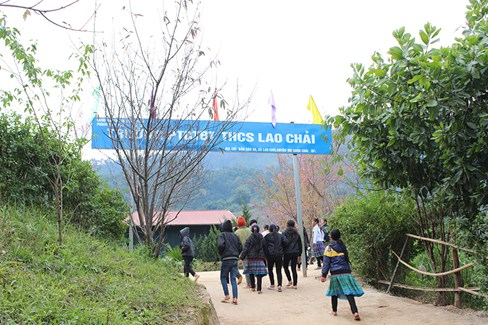
My first impression was how polite the students were. Seeing strangers arrive, they continuously nodded in greeting, but as soon as they caught sight of a camera lens, they would hurriedly turn away. According to the teacher, from the moment the gifts arrived a few days prior, the children were already bubbling with excitement, eagerly counting down the days until our group came to visit. While our delegation chatted with the teachers to learn more about the teaching and learning conditions at the school, the children gathered in the middle of the courtyard. Some of the boys were busy helping their teachers carry boxes of candy, snacks, and clothing. The atmosphere instantly came alive, with the lively laughter and shouts of children echoing across the mountains and forests.
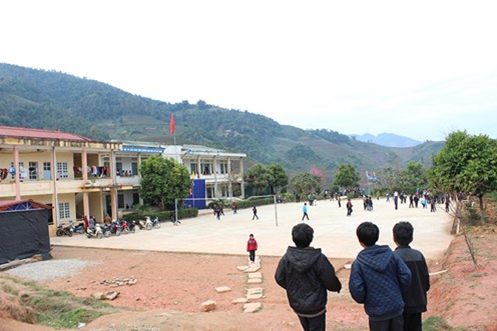
Looking at the overall exterior, the school appears quite well-built and spacious, but the facilities, classrooms, and living conditions for the teachers and students here still face many hardships.
Because the outdoor temperature was dropping low while the children were not warmly dressed, our delegation quickly proceeded with presenting the gifts so they could return to the boarding house, while others prepared for their upcoming shift of classes. Although the school appears quite well-built from the outside, the reality is that there is still a shortage of classrooms, forcing students to attend school in shifts. Teachers here have had to pool their own personal money to build additional facilities for their needs. For instance, the spacious, newly paved concrete courtyard—now solid and clean—was also a project undertaken by the teachers with a helping hand from parents. Ms. Lieu joked: 'The teachers here double as both educators and construction workers, folks!
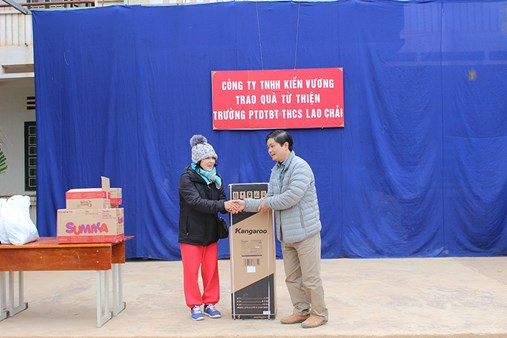
Ms. Phung, on behalf of the charity group, gives a hot and cold water tower to the teachers
Crossing the steep path lined on both sides with wild peach blossoms in full bloom, we followed the students to the semi-boarding house a few hundred meters away. Though called a semi-boarding model, in reality, the students live almost full-time on campus. The entire school currently has 8 boarding rooms, each measuring about 50 square meters—windowless and pitch-black, with light entering only through the doorway. Clothes hang everywhere, draped over wire lines. Twenty-five bunk beds are crammed tightly together, serving as the sleeping, playing, and studying space for over 50 children. To move around, one person has to sit up on a bed to make way for another to pass. The girls' quarters are no better. Though prioritized with a two-story brick building, the facility is deteriorating, with large patches of paint peeling from the walls and ceiling. Beds and aluminum storage trunks are scattered across the room, while dresses and clothes completely cover the iron railings on the rear balcony. Like so many schools in these high-altitude border regions, the greatest obstacle facing the students is sanitation. As mentioned, the current student population has already exceeded the original design capacity and is expected to keep growing, yet the entire school has only one restroom for boys and one for girls.
Also according to Ms. Lieu, the school was originally built with a capacity for only 200 students. Today, that number has reached 584. The dormitories and auxiliary facilities can no longer meet their needs. To make room for the students to stay, the school had to convert the cafeteria into living quarters and utilize a section of the courtyard as a dining area—just enough to provide basic shelter from the sun and rain.
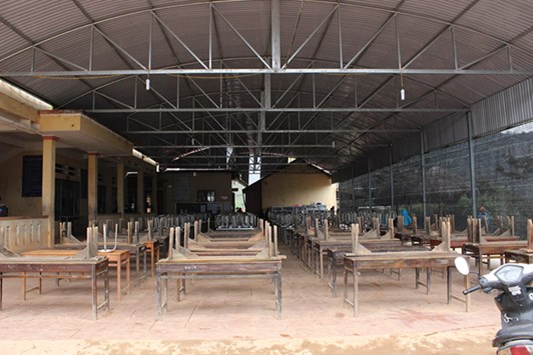
The courtyard that was once a playground for the children has now been repurposed as a dining area.
Currently, the teachers and students at Lao Chai Semi-Boarding Secondary School for Ethnic Minorities are gradually overcoming their difficulties, with daily meals being given special attention by the school. Teachers organize activities for the students to engage in farming and livestock production—such as growing vegetables and raising pigs—both to supplement their daily meals and to teach them practical life skills. It is known that the vegetables grown by the teachers and students themselves supply 70% of the green produce for the school kitchen, while the livestock helps improve the students' meals and provides special dishes for holidays and festive occasions. On this visit to the school, alongside blankets, sweets, warm jackets, and plastic sandals for all 584 students, Kien Vuong also contributed additional essential provisions for the kitchen.
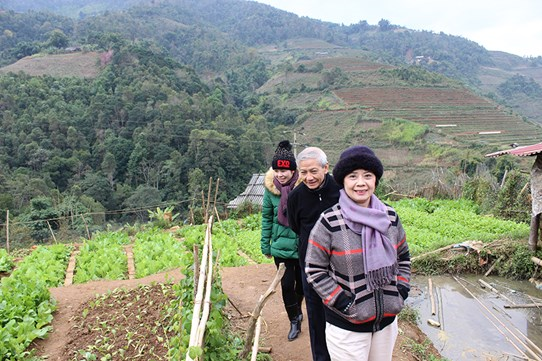
Ms. Lieu led the delegation to visit the lush green vegetable garden, carefully tended by the teachers and students each day.
We may not have the power to single-handedly alter their circumstances or resolve every hardship faced by the teachers and students; we only hope to join hands with the teachers to help 'keep' the children coming back to school to receive a proper education, so that they themselves will be the ones to paint a bright future for their own lives!
Leaving Lao Chai Commune, as we passed the fork in the road leading to Ta Ghenh Village on our way back, we were reminded of the image of teachers heading to class every day with mud-caked feet. This stirred up a deeply conflicted realization: 'Whenever I visit a place that is truly impoverished and struggling, I feel both deep compassion and a sense of joy. Anyone can understand the compassion, but the joy comes from knowing we have reached the right place, the right people, appearing when they need us most. Yet putting it that way might make others think we wish for them to be poor.' It is precisely because of this mindset that Mr. Qui and Ms. Hien always make a point to visit in person to understand the actual conditions, ensuring that every act of assistance delivers the most practical and meaningful impact.


