
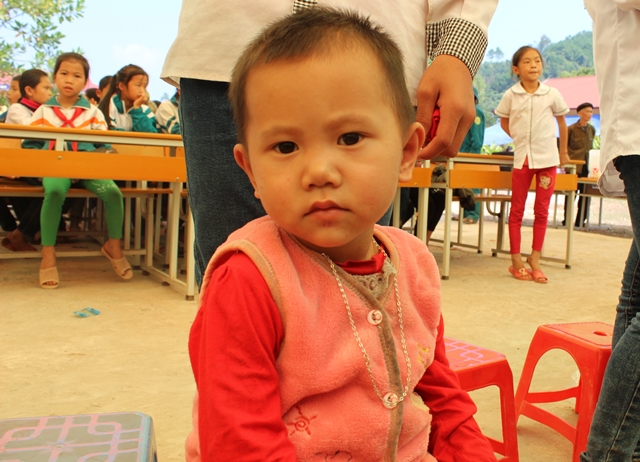
A Sad Story in a Remote Commune
What do you see after the volunteer trips that have passed?
It’s not the worldly things people often call "fame."
It’s only human warmth when sharing a small piece
A piece of bread, a warm sweater, or a pair of jungle sandals.
What do you see beyond those cheering voices?
It’s the image of a 5-year-old carrying a younger sibling who still craves milk.
Up in those highlands, people must be living hand-to-mouth for every meal, right?
Yes, that’s true. Those kids in the high mountains suffer so much!
In the winter, every child’s face turns bright red
Not from the harsh sunlight, but from the freezing winter cold.
Yet how many feet actually get to wear a pair of sandals?
Even for the little ones, their shirts are torn to shreds!
In the city, we ride our scooters along so smoothly.
Try going to the highlands once, and you won't be able to hold back your tears.
Not because of the things we always wonder about,
But simply when seeing a meal that doesn't even have a piece of pickled eggplant!
The early morning weather in this mountainous region was truly cold! Thick fog covered the entire area. The car rolled smoothly through the misty white air. Everyone looked quite exhausted, but still tried to tease the driver: "Drive strong, driver! We’re preparing to close our eyes and continue our journey into dreamland!" The whole car burst into laughter for a moment, and then gradually fell silent as everyone drifted off to sleep…
7:30 AM… The program began with a series of consecutive activities. This time, Kiến Vương presented 200 sets of clothes, 200 warm coats, and 200 pairs of sandals to underprivileged children from elementary to secondary school.
These gifts were divided and distributed to the 3 poorest communes in Lạng Sơn Province: Nhượng Bạn, Yên Khoái, and Xuân Mãn. That was the original plan, but because there were many events happening that day, the Organizing Committee decided to go directly to Nhượng Bạn commune to present the gifts in person. The remaining gifts were sent to the Youth Union members of Yên Khoái and Xuân Mãn communes to deliver to the children later.
From the event location to Nhượng Bạn commune was about 30 kilometers. This is one of the 3 most economically disadvantaged communes in the province. 100% of the population belongs to the Sán Chỉ ethnic group; they have bound their lives to the forest, clinging to it since the hardest days.
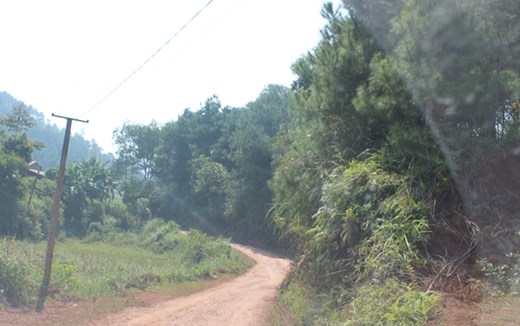
Road to Nhượng Bạn Commune
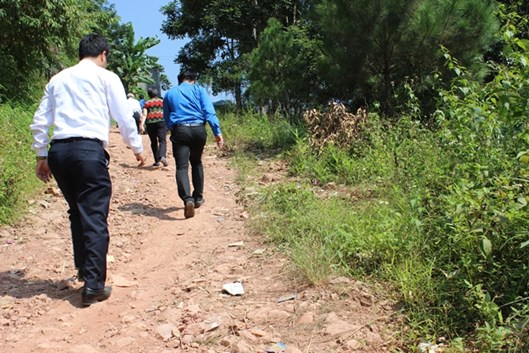
To reach the school point—the venue for the presentation ceremony—the group had to trek on foot, climbing up a remarkably steep slope
That day, I had the opportunity to talk with Uncle Dầu—the former Chairman of the Nà Pán Cooperative. He still vividly remembered about 15 years ago, when this Nhượng Bạn commune had no electricity, no roads, and the locals had no idea how to make a living... Every year, they could only grow a single crop of upland rice, and "every season, the weeds grew taller than the rice." Poverty clung to them like a shadow among the pine hills that were planted merely for firewood. Every day, people carried firewood on shoulder poles, walking miles to the district market just to sell it, making barely enough money to buy a tin of salt or a kilogram of rice.
He told me that ever since the locals started planting Masson pine trees (thông mã vĩ) to harvest resin and process wood, their lives have gradually stabilized. But the children here still suffer tremendously. Because besides lacking food, they also endure the pain of losing their fathers—fathers who ended up in prison for smuggling goods across the border.
The moment he finished his sentence, Uncle Dầu turned and pointed out a little girl who was wiping her 2-year-old sibling's face, then continued: "Look no further than little Bẻng right over there. There are only two sisters in her family, living with their mother. Her father was arrested—arrested a long time ago. Seeing his two daughters starving, he fell for people's persuasion and took a desperate risk, bringing goods across the border to sell illegally to evade taxes, and ended up in prison. Now her mother works the mountain fields, so she has to carry her baby sibling on her back to school every day."
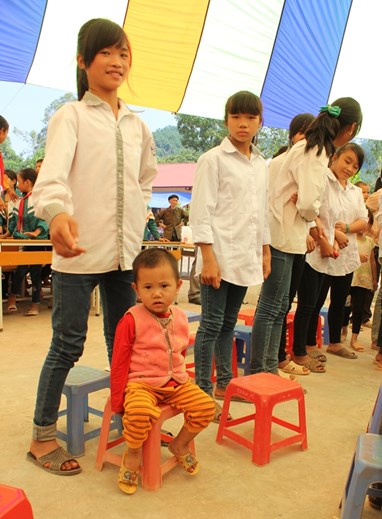 Two siblings of Phì Bẻng family
Approaching to talk with her, the 6th-grade girl was initially too shy to speak with me. Only after Uncle Dầu spoke up did she begin to open up.
Answering me in fluent Vietnamese, Phì Bẻng shared that Phì Lú had been sleeping on her back since Phì Lú was less than a year old. Their mother had to go work in the mountain fields, working to buy rice for them to eat. Whenever the house ran out of rice, her family would eat mèn mén (a traditional corn-based staple of the ethnic minority people).
"So when Phì Lú wasn't even a year old and you already had to carry her to school, how did you study? How did you take care of her?"
"Phì Lú is very good, sister. In the morning, my mother cooks rice, drains off the warm rice water into a bottle, and gives it to Phì Lú to drink. When I’m in class studying, Phì Lú just sleeps. Whenever she cries, I feed her the rice water again. If she cries too much, my teacher helps me soothe her."
"Does Phì Lú not have milk to drink?"
"Only whenever my mother goes to the District market to sell firewood and corn does Phì Lú get to drink milk."
"What about you? How about you? Do you find studying difficult? Does having to study while taking care of your baby sister affect your schoolwork?"
"It's okay, sister. I'm used to it. I have to learn how to read and write! I need to get an education so I won't be fooled like my father. That's what my mother tells me."
My heart tightened as I listened to Phì Bẻng's innocent answers. Meanwhile, Phì Lú just kept staring at me—probably because I was a stranger to her.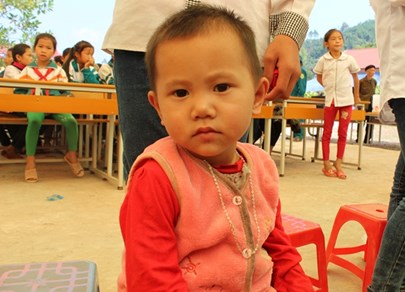 At such young age, little Phì Lú has had to endure far too much hardship and disadvantage
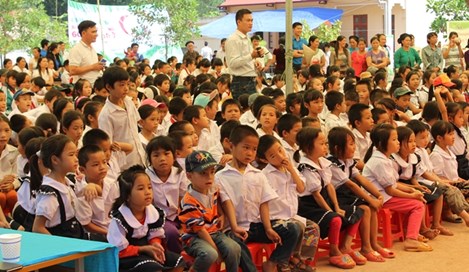
As for most of the other children here, despite being in 6th grade, every single one of them was tiny and undersized due to malnutrition
11:30 AM…The donation ceremony came to an end, and we boarded the car to head back. Sitting inside as we traveled down the winding, tortuous road, the car lurched up and down continuously over the uneven, bumpy terrain.
I found myself thinking: perhaps only when the roads are fully built and improved will the lives of the people here truly have a chance to develop. Only then will little children like Phì Lú regularly have milk to drink, and Phì Bẻng will no longer have to strain her small shoulders carrying her baby sister on her back in pursuit of an education.
But… when will that thought ever become a reality?!


